
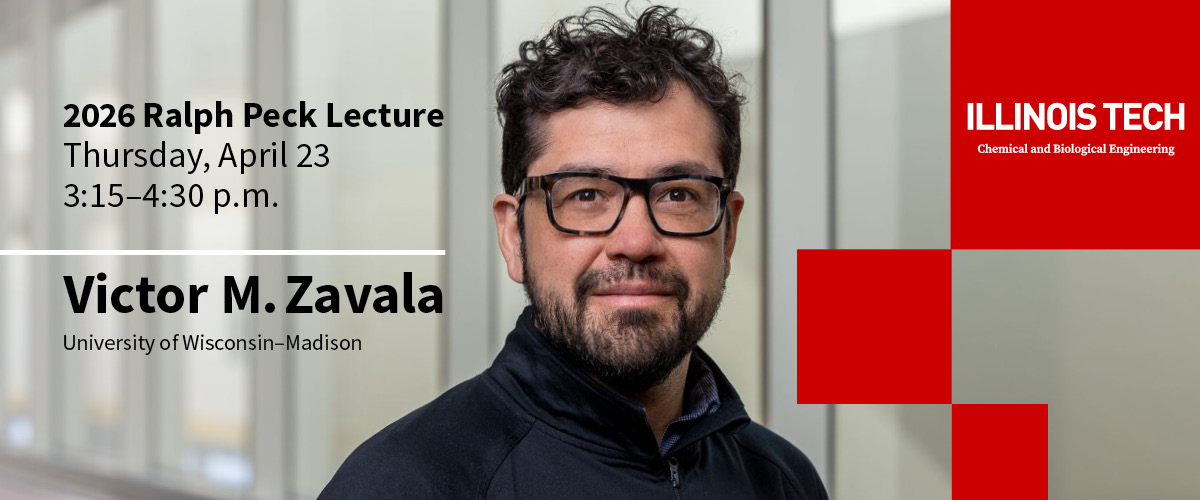
The Illinois Tech community is invited to the 2026 Ralph Peck Lecture on Thursday, April 23, at 3:15–4:30 p.m. in the Perlstein Hall Auditorium (room 131). Victor M. Zavala, Baldovin-DaPra Professor in the Department of Chemical and Biological Engineering at the University of Wisconsin–Madison, will present the lecture, titled “From Molecules to Supply Chains: Transforming Data to Decisions Using Geometry, Optimization, and Machine Learning.”
Georgia Papavasiliou, professor and chair of the Department of Chemical and Biological Engineering at Illinois Tech, will introduce Professor Zavala. In addition, recipients of the 2025 Charles W. Pierce Distinguished Alumni and Young Alumnus Award will be honored.
A reception will follow the lecture.
Biography
Victor M. Zavala is the Baldovin-DaPra Professor in the Department of Chemical and Biological Engineering at the University of Wisconsin-Madison. He is also affiliated with the Mathematics and Computer Science Division at Argonne National Laboratory. Zavala holds a bachelor of science degree from Universidad Iberoamericana and a Ph.D. from Carnegie Mellon University, both in chemical engineering. He is an associate editor for Industrial & Engineering Chemistry Research and is on the editorial board of the Mathematical Programming Computation and Computers & Chemical Engineering. He was a recipient of National Science Foundation and United States Department of Energy early career awards and of the Presidential Early Career Award for Scientists and Engineers. His research interests include data science, control, and optimization and their applications to chemical, energy, and environmental systems.
Abstract
We will discuss how geometry, optimization, and machine learning are key technologies that are revolutionizing the way that we think about data and the way that we transform data into actionable models and decisions. Specifically, I will explain how complex data (e.g., text, molecules, time series, images/video, supply chain flows) can be represented as geometrical objects and how this facilitates interpretation and extraction of useful information from data. We will also discuss how extracted information can be mapped into decisions using optimization and machine learning models. I will illustrate how to use these powerful math tools in innovative ways for analyzing complex datasets arising in molecular dynamics simulation, protein design, microscopy, chemical processes, and supply chains. Specifically, I will show that these tools can help link the microstructure of soft gels to their rheological properties, can help analyze complex responses of liquid crystals from video data, and can help detect anomalies and optimize large-scale systems.
About Ralph Peck
Ralph Peck was a dynamic teacher and researcher whose genuine concern for students made him a legendary figure at Illinois Tech and in the field of chemical engineering. After receiving his bachelor and Ph.D. degrees from the University of Minnesota, he introduced his own method of teaching, “the 10-minute quiz,” for which he became famous—or infamous.
Ted F. Meinhold (ChE ’43) of Wauconda, Illinois, writes, “My favorite professors were Harry McCormak and Ralph Peck, both in the chemical engineering department. Tough task masters, but splendid tutors!”
In 1939, Peck came to Armour Institute of Technology (an Illinois Tech predecessor) as an instructor in chemical engineering and quickly rose through the faculty ranks. In 1953, he became chairman of the Department of Chemical Engineering at Illinois Tech and held that post until 1967. He traveled extensively, introducing his teaching methods and philosophy in India, Israel, Brazil, Algeria, Korea, and Japan. He also supervised 100 master’s students and 33 Ph.D. degree candidates. Four patents were issued in his name.
He received the Excellence in Teaching Award from Illinois Tech in 1973, as well as the Western Electric Fund Award for Teaching Excellence for 1975–76 from the American Society for Engineering Education. He was a fellow of the American Institute of Chemical Engineers and a member of the American Chemical Society and the ASEE. He died in Chicago in 1982.