
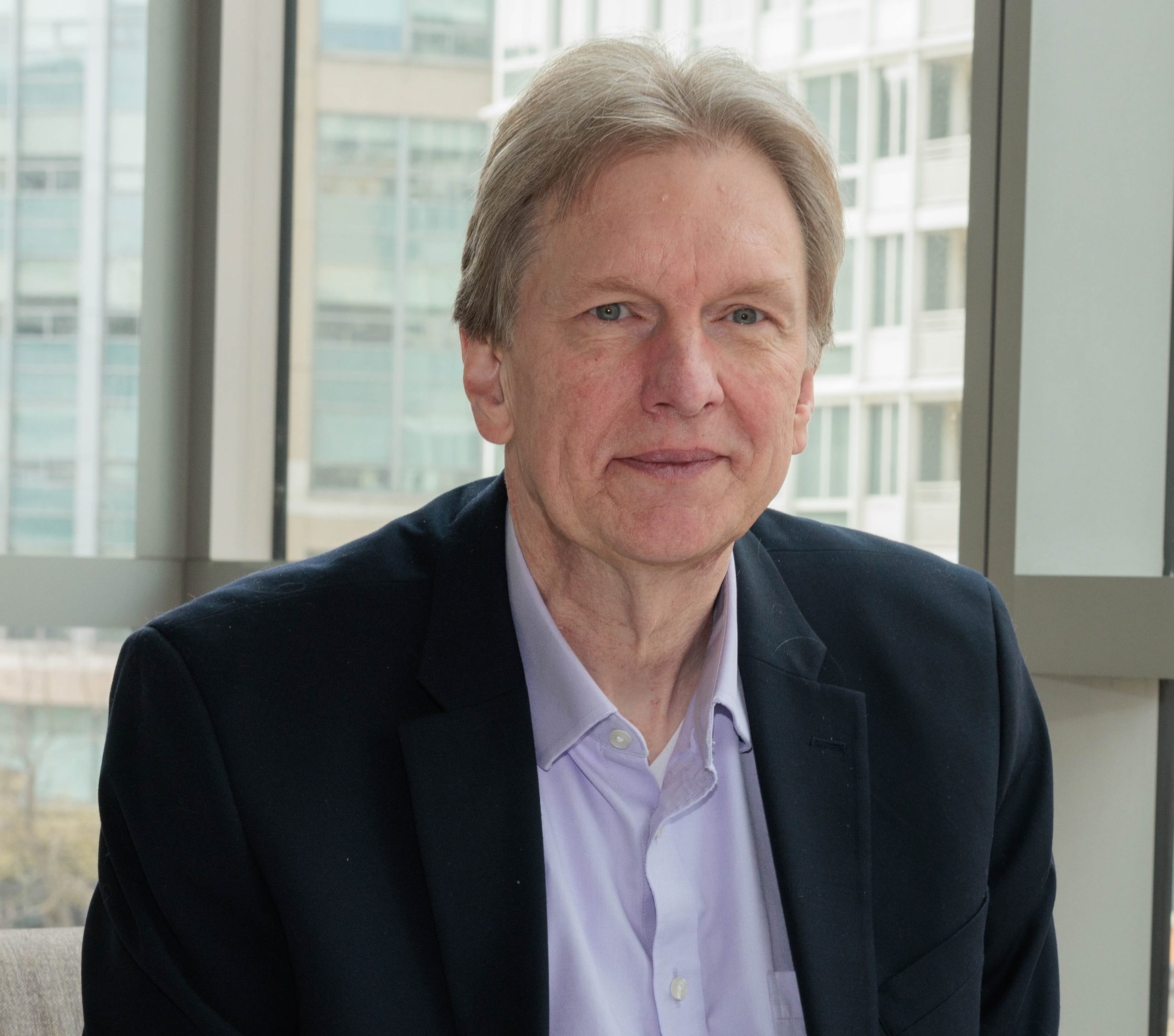
Michael Plesniak, SEAS, engineering
The Department of Mechanical, Materials, and Aerospace Engineering welcomes the 2026 Distinguished Alumnus Michael Plesniak, Professor and Chair of the Department of Mechanical & Aerospace Engineering at the George Washington University, who will present “Vortex Dynamics Downstream of a Surface Protuberance in Highly Pulsatile Flow Motivated by Human Speech Pathologies.” This seminar is open to the public and will take place on Friday, April 17, 2026, from 3:30–4:30 p.m. in room 131 (auditorium) of Perlstein Hall. MMAE Departmental awards will immediately follow the seminar.
Abstract
This study was motivated by flow over a vocal fold polyp which is a pathology that occurs in human speech production, or phonation. Speech production involves unsteady pulsatile flow and turbulent structures that affect the fluid-tissue interaction and aeroacoustics. Voice disorders are prevalent, affecting nearly 30% of the population during their lifetimes and resulting in an annual cost of treatment of over $10 billion, as well as significant degradation of quality of life. The overarching motivation for studying flow associated with phonation is to facilitate evaluation and design of disease treatment interventions and for surgical planning. We also seek to inform non-surgical clinical treatment strategies of voice disorders in collaboration with speech pathologists. Silicone-based, self-oscillating synthetic vocal fold (VF) models are fabricated in our lab with material properties representative of human VFs and then evaluated experimentally in a life-size in vitro vocal tract simulator to replicate physiological conditions. Our experimental investigations utilize high-speed imaging, particle image velocimetry (PIV), pressure transducers and microphones, and the clinical Rothenberg mask. Studies are performed under both normal and pathological conditions of speech. Recent attention in our phonation studies has been focused on understanding the role of polyps (growths on the vocal folds) in altering voice quality. This has necessitated fundamental studies of 3D flow separation around surface-mounted obstacles in pulsatile flows. In addition to experiments utilizing time-resolved particle image velocimetry (TR-PIV) we have performed CFD simulations using an in-house Navier-Stokes code. This seminar will focus on fundamental studies of pulsatile flow over a surface protuberance, or bump, with introductory material to illustrate the speech pathology motivation.
Biography
Dr. Michael W. Plesniak is Professor and Chair of the Department of Mechanical & Aerospace Engineering at the George Washington University, with a secondary appointment in the Department of Biomedical Engineering. Professor Plesniak is the Director of GW’s Center for Biomimetics and Bioinspired Engineering. He was formerly Professor of Mechanical Engineering at Purdue University and Eugene Kleiner Professor for Innovation in Mechanical Engineering at Polytechnic University in Brooklyn, NY. He served as the Director of the Fluid Dynamics & Hydraulics program at the National Science Foundation from 2002-2006. Prof. Plesniak earned his Ph.D. degree from Stanford University, and his M.S. and B.S degrees from the Illinois Institute of Technology; all in Mechanical Engineering. Dr. Plesniak is a Fellow of AIAA, ASME, the American Physical Society (APS), the American Society of Thermal & Fluids Engineers (ASTFE), the American Institute for Medical and Biological Engineering (AIMBE), the Association for the Advancement of Science (AAAS) and the Washington Academy of Sciences. He has authored over three hundred refereed archival publications, conference papers and presentations, and has presented numerous invited seminars and keynote addresses. His research group is currently studying the pulsatile flows, physics of phonation, cardiovascular flows and tissue engineering. Prof. Plesniak was a recipient of the 2018 Washington Academy of Sciences Distinguished Career in Engineering Award, 2017 ASME Fluids Engineering Award, and the 2011 NASA DC Space Grant Consortium’s Outstanding STEM Faculty Award, awarded to faculty that make an outstanding contribution to STEM that goes above and beyond the classroom. Dr. Plesniak was also named the American Institute for Aeronautics and Astronautics, National Capital Section Engineer of the Year 2010-2011.